
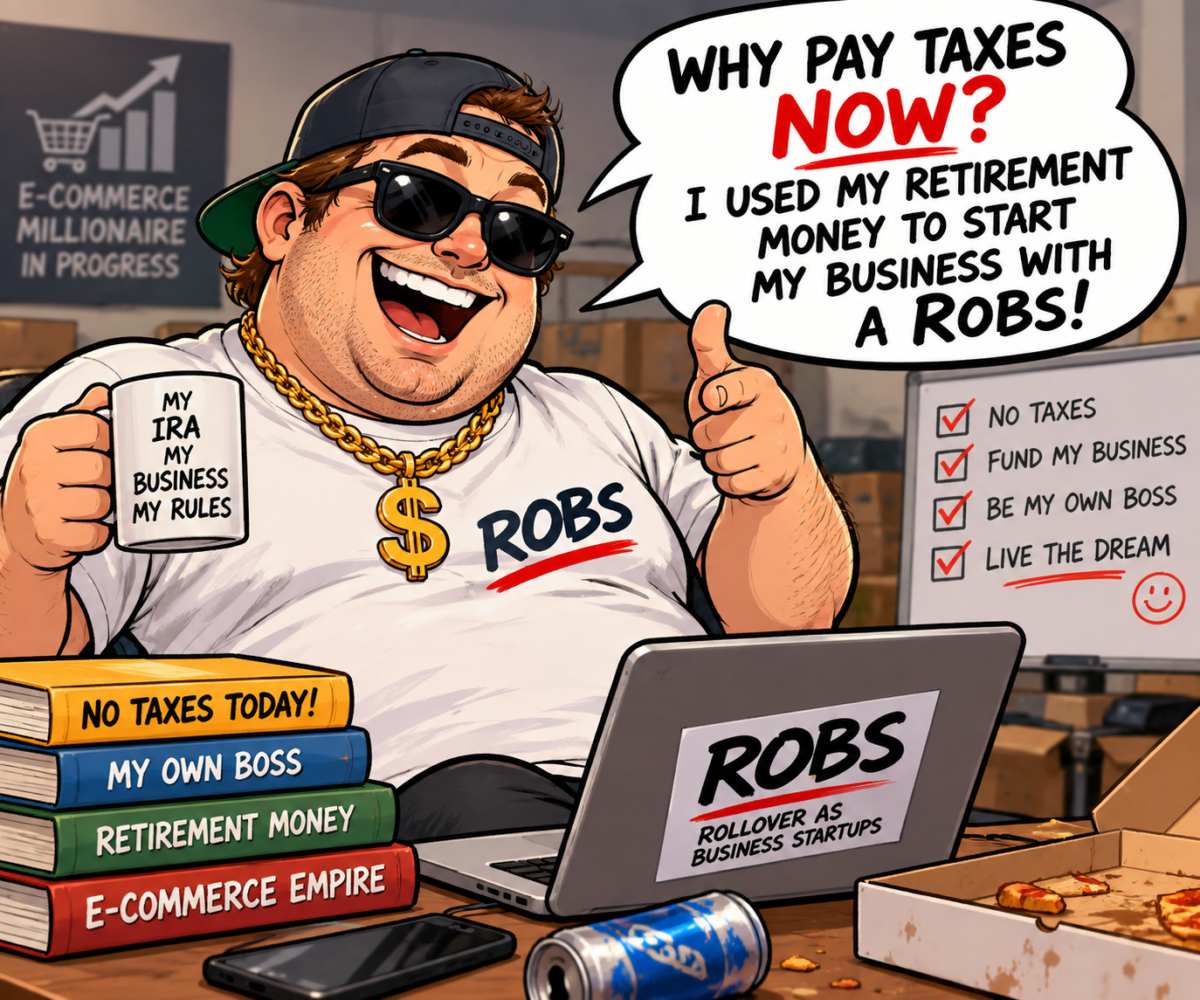
I understand why a ROBS sounds attractive.
You have $150,000 sitting in an IRA or 401(k). You want to start or buy a business. If you simply withdraw the money, you may owe income tax plus a 10% early-distribution penalty. Then someone tells you there is another way.
Set up a ROBS—Rollover as Business Startups—and you may be able to use retirement money to fund the business without immediately paying income tax or the 10% penalty.
Sounds great.
But before you spend thousands of dollars setting one up, do the math beyond year one.
I think too many ROBS discussions focus on the tax you avoid today and not enough on the tax structure you may be operating under for years afterward.
A ROBS Changes More Than How You Fund the Business
ROBS arrangements are generally structured through a C corporation.
A qualified retirement plan is established by the corporation, retirement funds are rolled into the plan, and the plan purchases employer stock. The corporation then has the cash available to operate the business.
That’s the part everyone likes.
You moved retirement money into the business without creating an immediate taxable retirement distribution.
But now you own a C corporation.
For many profitable owner-operated businesses, particularly ecommerce businesses, I would normally consider whether an S corporation makes more sense.
With an S corporation, the owner takes reasonable compensation as wages and the remaining business profit passes through to the shareholder. That remaining S corporation profit generally isn’t subject to Social Security and Medicare taxes.
That difference can become very important once the business starts making money.
Let’s Actually Run the Numbers
Consider a married taxpayer with two children.
They already have $150,000 of household income and need another $150,000 to start an ecommerce business.
Let’s assume the business loses $50,000 during startup. Once established, it produces approximately $200,000 per year before owner compensation.
We’ll also assume that reasonable compensation for the owner would be approximately $125,000 if the company were an S corporation.
And there is one more important assumption:
The owner needs the profits from the business to support their household.
This isn’t someone building a company so they can accumulate cash inside it for the next 20 years. They started the business because they eventually expect it to provide their income.
There are two basic choices.
Option 1: Withdraw $150,000 from the retirement account, pay the tax and early-distribution penalty, contribute the money to an S corporation and potentially deduct the $50,000 startup loss.
A $150,000 capital contribution should generally create sufficient stock basis for a $50,000 S corporation loss, but basis isn’t the end of the analysis. The loss still has to clear the at-risk, passive-activity, excess-business-loss and other applicable limitations.
Option 2: Establish a ROBS, avoid the taxable retirement distribution and operate through the C-corporation structure.
The ROBS wins easily on Day One.
But Day One isn’t where the analysis should stop.
The Initial Comparison
Using 2026 federal tax rules, our simplified example looks approximately like this:
| Initial Funding Comparison | IRA Withdrawal + S Corp | ROBS + C Corp |
|---|---|---|
| Retirement money used | $150,000 | $150,000 |
| Taxable retirement distribution | $150,000 | $0 |
| First-year business loss | ($50,000) potentially passes through | ($50,000) remains in corporation |
| Net increase to personal AGI in example | $100,000 | $0 |
| Additional federal income tax | ~$22,100 | $0 |
| 10% early-distribution penalty | $15,000 | $0 |
| Approximate initial federal cost | ~$37,100 | $0 |
| ROBS setup cost | $0 | Additional setup cost |
At this point, the ROBS looks pretty good.
Avoiding approximately $37,000 of tax and penalty gets my attention too.
But now let’s assume the ecommerce business succeeds.
That’s when the analysis gets more interesting.
Congratulations. The Business Makes $200,000. Now How Do You Get the Money Out?
This is the part I think gets lost in the ROBS sales pitch.
Getting the $150,000 into the corporation isn’t the end of the tax planning.
Eventually, you have to get money out of the corporation.
Our hypothetical owner needs the business income to live. The mortgage, groceries and everything else in life aren’t paid by the C corporation retaining earnings.
Once the business is profitable, there are basically three places the remaining C-corporation profits can go.
1. Pay More Wages
The corporation can pay additional compensation to the owner.
Wages are generally deductible by the corporation, but they’re also subject to payroll taxes.
And there is another issue: compensation has to be reasonable for the services actually performed.
This works differently from the S corporation issue many business owners have heard about. With an S corporation, the IRS may challenge compensation that is too low when owners take large distributions instead of wages.
With a C corporation, paying excessive compensation to eliminate corporate taxable income can create the opposite problem. Compensation that isn’t reasonable can potentially be challenged as a nondeductible distribution rather than deductible wages.
So “just pay everything as salary” isn’t necessarily the answer.
2. Pay Dividends
Fine. Don’t pay everything as wages.
Let the C corporation earn the profit and distribute the remaining cash as dividends.
Now you potentially have two levels of tax.
The corporation pays corporate income tax because dividends aren’t deductible by the corporation.
Then the shareholder may pay tax on the dividend when the remaining money is distributed personally.
You avoided payroll tax on the dividend, but that doesn’t mean you avoided tax.
You just changed which tax you’re paying.
3. Leave the Money in the Corporation
You can do that too.
The C corporation pays tax on its taxable income and retains the remaining cash.
For an owner who doesn’t need the money personally, that can change the analysis considerably.
But that isn’t our example.
Our owner needs the profits from the business to support their household.
Leaving $50,000 or $75,000 sitting inside a corporation every year doesn’t pay personal expenses.
There Isn’t a Magic Fourth Door
This is really the point.
Once a profitable owner-operated business is inside a C corporation, the owner doesn’t have a magical fourth option for getting the profits home.
You can:
Pay wages.
Pay dividends.
Leave the money in the corporation.
All three have tax consequences.
Meanwhile, an S corporation potentially allows the owner to receive reasonable compensation and then take additional business profits as S corporation distributions that generally aren’t subject to Social Security and Medicare taxes.
That’s why I don’t like analyzing a ROBS by looking only at the tax avoided when the business is funded.
You need to model how the business is going to operate after it becomes successful.
An Example of the Payroll-Tax Difference
Let’s look at one possible scenario.
Assume our owner needs substantially all of the business cash flow personally and takes additional deductible compensation from the C corporation, with the important caveat that total compensation must still be reasonable for the services performed.
Using 2026 payroll-tax rules, our illustration produces approximately $9,145 of additional combined employer and employee payroll taxes compared with the S-corporation example.
The employer portion of those additional payroll taxes is deductible. Assuming approximately a 22% income-tax benefit from that deduction reduces the economic cost by roughly $1,000.
That leaves an estimated:
$8,140 of additional annual payroll-tax cost.
That’s roughly $678 per month.
And that’s before considering ROBS administration costs.
Over ten years, if we simply held the 2026 payroll-tax rules constant for illustration, that would be approximately $81,400 of additional payroll-tax cost.
That is not a prediction of what the actual tax will be ten years from now. Social Security wage bases, tax rates, compensation and business income change.
It’s an illustration of why I don’t think the analysis should end with the tax saved on Day One.
And We Haven’t Given the S Corporation Credit for QBI
There is another potential advantage that isn’t included in that payroll-tax comparison.
An S corporation shareholder may qualify for the Section 199A qualified business income deduction on qualifying pass-through income.
Shareholder wages aren’t QBI, and C-corporation income doesn’t qualify for the shareholder’s QBI deduction.
Whether an owner qualifies and how much of a deduction is available depends on taxable income, wages, the nature of the business and other limitations.
So I’m not going to automatically plug a 20% deduction into a ten-year projection and pretend we know exactly what the deduction will be.
But it belongs in the analysis.
Ignoring it potentially makes the ROBS look better, not worse.
Don’t Forget the First-Year Loss
Our hypothetical ecommerce company loses $50,000 during startup.
With the S corporation, that loss may flow through to the shareholder’s individual return.
A $150,000 capital contribution should generally provide enough stock basis for the $50,000 loss, but the loss still has to satisfy the at-risk, passive-activity, excess-business-loss and other applicable rules.
With the C corporation used in the ROBS structure, the $50,000 operating loss doesn’t pass through to the shareholder’s individual return.
It remains a corporate tax attribute subject to the C corporation’s net operating loss rules.
That’s another economic difference that can disappear when the entire discussion revolves around one sentence:
“You can use your retirement money without paying tax or penalty.”
Yes, you can.
What happens after that?
ROBS Also Comes With Compliance
There is another part of the discussion that shouldn’t be ignored.
A ROBS isn’t simply an entity election.
You now have a qualified retirement plan owning employer stock.
That brings retirement-plan compliance requirements into the picture, including plan administration, required filings, nondiscrimination requirements and employee participation issues.
Valuation matters too.
The retirement plan is purchasing employer stock, and that stock needs to be properly valued. You don’t simply decide the new company is worth exactly however much money happens to be sitting in your retirement account and call it a day.
None of this means a ROBS is improper.
It means it’s a structure that needs to be established and administered correctly.
That costs money and requires attention.
ROBS Aren’t Free Money
A ROBS can absolutely make sense in the right situation.
If someone has substantial retirement assets, doesn’t have another reasonable source of capital, needs the money to acquire or start a business and expects the economics of that business to justify the C-corporation structure, it deserves consideration.
But a ROBS isn’t a tax deduction.
It isn’t free financing.
And it doesn’t magically turn retirement money into tax-free business capital.
You’re avoiding an immediate taxable retirement distribution in exchange for operating within a more complicated retirement-plan and corporate structure.
Sometimes that’s a very good trade.
Sometimes it isn’t.
Start With the Business You Expect to Have Five or Ten Years From Now
This is where I think the analysis should begin.
Don’t ask:
“How much tax will I owe if I withdraw $150,000 from my retirement account?”
Of course that number is going to look terrible.
Ask:
“What will each option cost me over the period I expect to own the business?”
Model the startup loss.
Model reasonable compensation.
Model payroll taxes.
Model corporate income tax.
Consider dividends.
Consider the QBI deduction.
Include ROBS setup and annual administration.
Consider how much money the owner actually needs to take out of the business to live.
And don’t forget what eventually happens to the money accumulated inside the corporation.
Then compare the numbers.
If the ROBS still wins, great. At least you made the decision based on the economics of the business rather than a sales pitch about avoiding a 10% penalty.
But if you’re planning to build a profitable ecommerce company and operate it for the next ten years, don’t make a ten-year entity decision because you didn’t want to write a check to the IRS in Year One.
Do the math first.