
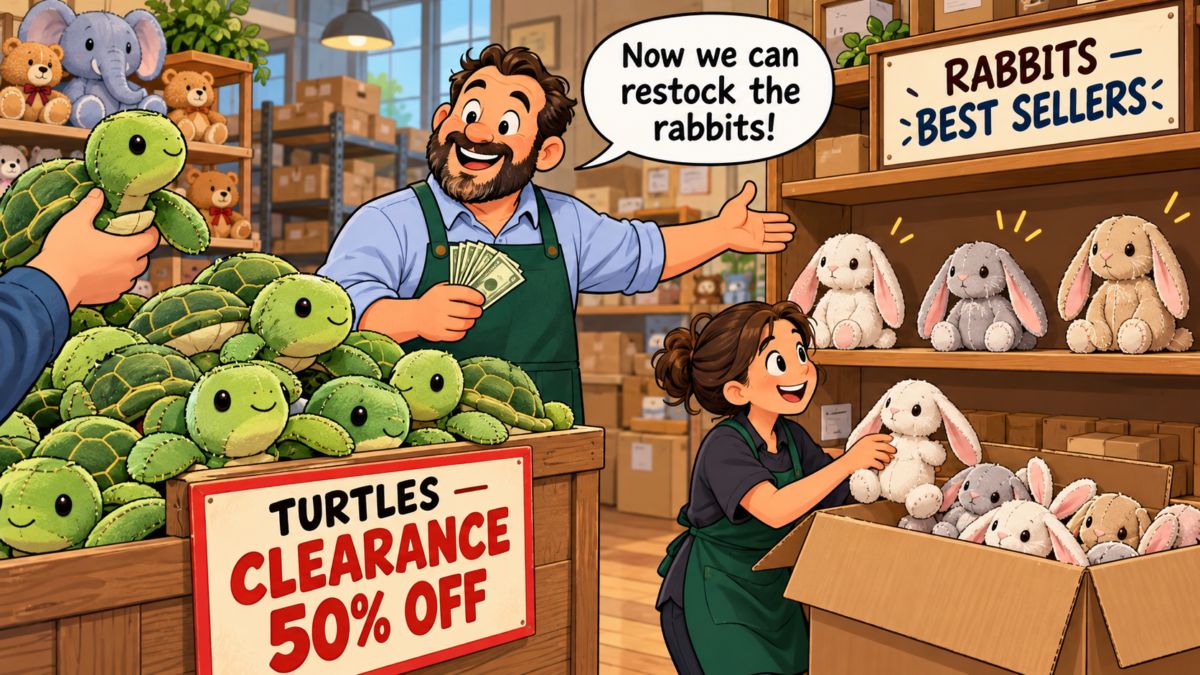
Ecommerce owners don’t usually like selling inventory for less than they paid for it.
That is understandable. The business purchased those products expecting to make money. Cutting the price enough to take a loss can feel like admitting the purchase was a mistake.
But when cash is tight, holding out for a better price may cost the business more than selling at a loss.
The question is what the business could do with the cash if it weren’t sitting on the shelf.
Inventory Doesn’t Pay the Bills Until It Sells
A business can have a warehouse full of inventory and still struggle to pay its bills.
The inventory has value, but the supplier, employees, and landlord generally expect to be paid in cash.
Meanwhile, products that sell well may need to be reordered. If too much cash is tied up in products that aren’t moving, the business may have trouble purchasing the inventory customers actually want.
At that point, keeping the slow-moving inventory at full price deserves another look.
Taking a Loss May Free Up a Better Opportunity
Suppose an ecommerce business has $10,000 invested in a product that has been sitting for months.
The owner still hopes to sell it for $15,000. But orders have slowed, and there is no clear indication of when the remaining units will sell.
A clearance sale could bring in $7,000 after the costs of selling those products.
That would leave the business with a $3,000 loss on the original purchase.
Nobody is excited about that result. But suppose the business also has another product that sells consistently and needs to be reordered.
The $7,000 could help purchase that inventory. If those products sell quickly enough and generate enough additional profit, recovering the cash could leave the business better off than continuing to wait.
The clearance sale still produced a loss. The benefit comes from what the business can earn by putting the recovered cash back to work.
Faster Sales Alone Aren’t Enough
Before moving the money into another product, make sure the replacement inventory is worth buying.
A product that sells quickly but leaves very little after product costs, fulfillment, marketplace fees, advertising, and returns may not solve the problem.
The business needs to understand how much cash the new purchase requires, how long it should take to sell, and how much should remain afterward.
In the example above, generating $1,000 of additional profit would not recover the entire $3,000 clearance loss. Generating more than $3,000 over a reasonable period could make the decision look considerably different.
Those expectations should be based on actual sales history and costs. Buying another product simply because it might sell better can leave the business with a different pile of slow-moving inventory.
Waiting Has Costs, Too
Holding inventory is not always free.
There may be storage charges, insurance, financing costs, or additional handling. Products can become damaged, outdated, or less desirable. Seasonal merchandise may face an even smaller market once the season ends.
There is also the cost of being unable to purchase something else.
If a reliable seller is out of stock while cash sits in products with little demand, the business may be giving up sales it could have made.
That does not mean every slow-moving item needs to be cleared out immediately. Some products take longer to sell and still produce a worthwhile return.
But waiting should be a decision supported by reasonable expectations.
Know How Much Cash the Discount Will Actually Produce
A clearance price is only the starting point.
Marketplace fees, payment processing, shipping, fulfillment, and advertising can reduce the amount available to reinvest. Returns may reduce it further.
A sale that generates $7,000 of revenue may leave considerably less than $7,000 to purchase replacement inventory.
Before setting the discount, work through what the business should actually collect and what it will cost to complete those orders.
If the business has bills coming due, some of the proceeds may also need to stay available for those obligations.
Use the Decision to Improve the Next Purchase
Once the inventory is sold, look at how it became slow-moving.
Was the original order too large? Did demand change? Was the margin less attractive after freight and other costs were included? Did the business keep reordering without reviewing what was already on hand?
The purpose is to make the next purchasing decision better.
Accurate inventory records, product costs, and sales information help identify problems before they consume as much cash.
What Can the Cash Do From Here?
The original inventory purchase has already happened.
The decision now is whether continuing to hold those products is the best use of the money tied up in them.
Sometimes waiting makes sense. Sometimes accepting a lower price gives the business room to pay bills, replenish stronger sellers, and generate more profit over time.
Selling at a loss is not automatically a good decision. But refusing to sell at a loss is not automatically a good decision either.
When cash is an issue, the business needs to understand both choices—and what each one means for the months ahead.