
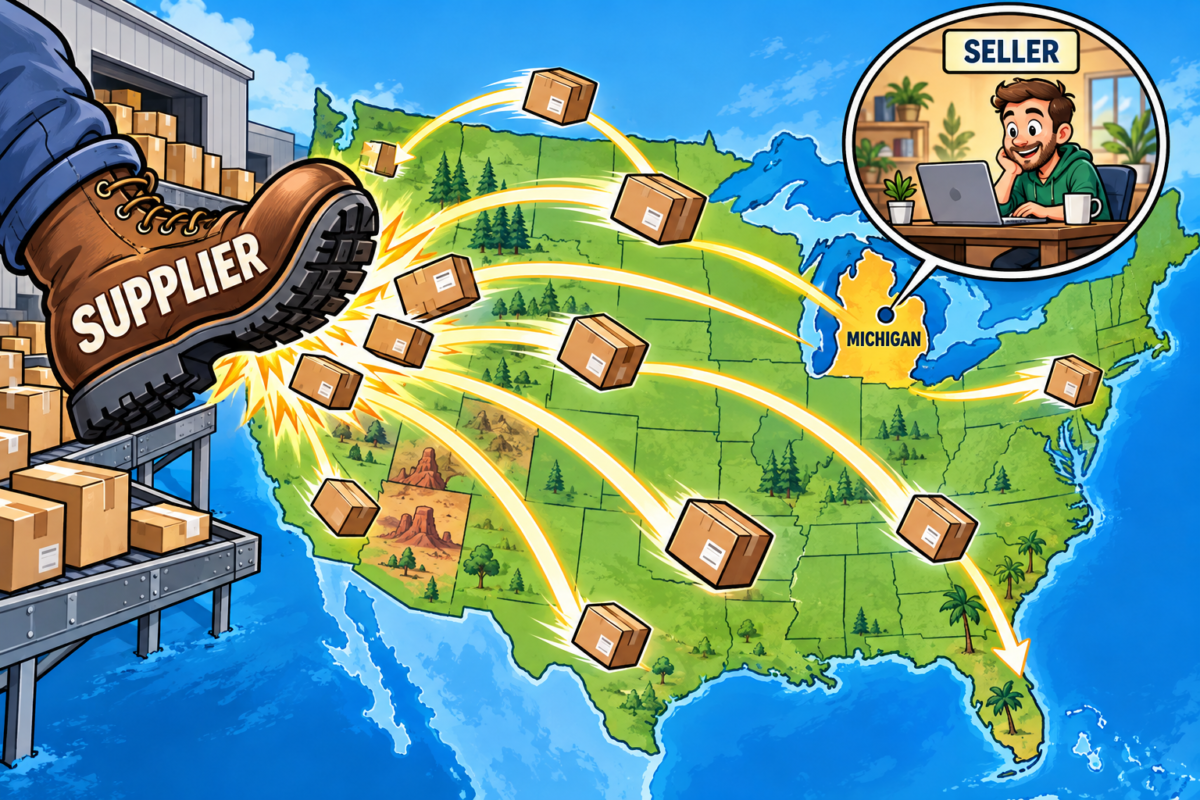
You run an ecommerce business from Michigan. Your supplier owns the products, keeps them in its warehouse, and ships them directly to your customers.
You never touch the merchandise. You don’t have a warehouse, an office, or employees in another state.
So you only need to worry about Michigan taxes, right?
Not necessarily.
Drop shipping can simplify your operations. It does not automatically limit your tax responsibilities to your home state.
What Does “Nexus” Mean?
The formal term for the connection that allows a state to impose certain tax obligations on your business is nexus.
That connection does not always require an office, employees, or inventory. For sales tax, enough sales into a state can create a collection obligation even when your business has no physical presence there. This is called economic nexus.
Sales tax and income tax also have different rules. Answering one question does not answer the other.
First, Whose Inventory Is It?
For this discussion, we are talking about a supplier that owns the merchandise until it is sold through a drop-shipping arrangement. You take the customer’s order, purchase the product from your supplier, and have the supplier ship it directly to the customer.
That is different from buying inventory in advance and storing it in an Amazon fulfillment center or another company’s warehouse.
In the second arrangement, you own inventory sitting in another state. In the first, the supplier holds its own inventory.
Those facts should not be treated as interchangeable. Your accountant needs to understand the agreement, including when ownership transfers and what the supplier does on your behalf. “We drop ship everything” is the beginning of that conversation.
Sales Tax Can Follow Your Customers
Even if you own no inventory in another state, your sales to customers there may create a sales tax obligation.
States have different economic nexus thresholds and different rules for calculating the sales that count toward them. A drop-shipping business needs to track sales by destination state and compare them with the applicable requirements. Having the supplier deliver the product does not remove the sale from that analysis.
The business also needs to distinguish sales made through a marketplace that handles tax from sales made directly through its own store.
The question is not simply, “Did someone collect sales tax?”
It is, “Who was responsible for collecting and remitting tax on this transaction, and was it handled correctly?”
Your Supplier May Ask for a Resale Certificate
A drop-shipping transaction generally involves two sales: your supplier sells the product to you, and you sell it to your customer.
That makes resale documentation important.
Do not assume your home-state resale certificate will satisfy every supplier for every destination. You need documentation acceptable under the rules that apply to the transaction.
California, for example, has specific drop-shipment rules that can make the supplier responsible for tax when delivering to a California customer on behalf of an unregistered out-of-state retailer. The retailer’s registration status and the resale documentation matter.
If your supplier starts charging tax, find out why. It may be a documentation issue or a consequence of the state’s drop-shipment rules. It does not, by itself, tell you whether all of your own obligations have been satisfied.
Income Tax Is a Separate Question
Sales tax gets much of the attention in ecommerce. State income tax deserves a separate review.
A business can have potential income tax exposure outside its home state even without an office there. State rules may consider sales and other business activities, subject to applicable federal protections.
One of those protections is Public Law 86-272. Under certain conditions, it prevents a state from imposing a net income tax when a seller’s activities in that state are limited to soliciting orders for physical products, with approval and shipment occurring outside the state.
That last part matters for drop shippers. Where orders are approved, where products ship from, and what activities occur in the customer’s state can affect the analysis. You cannot assume the protection applies simply because you never handle the merchandise.
The protection also concerns net income taxes. It is not a blanket exemption from sales tax or every other state business tax.
This does not mean every drop shipper owes income tax in every state where a supplier has a warehouse. It means the arrangement needs to be reviewed before someone concludes that only the home state matters.
What Should Your Accountant Review?
Before reaching a conclusion, your accountant should understand:
- Where your customers are located and your sales into each state.
- Which sales occur through marketplaces and which occur through your own store.
- Where your suppliers ship products from.
- When ownership transfers under your supplier agreements.
- Whether suppliers perform services beyond shipping, such as handling returns or warranty work.
- Which resale certificates, registrations, and tax filing arrangements are already in place.
These details help determine which states require attention and which tax rules apply.
Not handling inventory is an operating advantage. It is not enough information to conclude that your business has no tax responsibilities outside its home state.